
What does it mean to rank on ChatGPT?
Ranking on ChatGPT means being recommended or cited in its answers for the questions your buyers actually ask. It is earned through Generative Engine Optimization (GEO), not through keyword positions. There is no position 1 to win. There is a probability of appearing, and you can move it.
There are three different things people lump together, and separating them is the first step to getting anywhere:
- Being in the training data. The model learned about your brand when it was trained. Slow to influence, hard to measure, and you cannot edit it directly.
- Being retrieved live. ChatGPT pulls current results through an index tied to Bing and OpenAI's own crawlers, then cites pages in its answer. This is the fastest lever you control.
- Being recommended. The model names your brand as an option ("the best X for Y"). This leans heavily on how the wider web talks about you, not just your own site.
When someone asks "how do I rank on ChatGPT," they usually mean the second and third. Keep them straight, because the tactics differ.
You will also hear three acronyms used around this work, and they overlap heavily. Generative Engine Optimization (GEO) is the umbrella term: earning visibility inside AI-generated answers. Answer Engine Optimization (AEO) is the on-page slice of that work, structuring content so answer engines can quote it directly. LLMO (large language model optimization) is the same idea framed around the models themselves. Different labels, one job: make your brand part of the answer. For a deeper comparison of how this differs from traditional search, see our guide to GEO vs. SEO.
How does ChatGPT decide what to recommend?
ChatGPT decides mostly on consensus: how often, how consistently, and how credibly the rest of the web mentions your brand, combined with what it can retrieve live at the moment of the query. Your own website matters, but it is not the main event.
Two findings from other practitioners are worth knowing here, and I am crediting them plainly because they are not our numbers. Ahrefs analyzed 75,000 brands and found that YouTube mentions and mention impressions showed the strongest correlation with ChatGPT visibility. Neil Patel ran a separate test, asked ChatGPT 100-plus questions, handed the results to a statistician, and out of 82 factors found 6 that correlated with recommendations: brand mentions, reviews, relevancy, age, recommendations, and authority. Different studies, same headline: off-site signals dominate.
If you want a strong strategic overview of these factors, Power Digital's 7 tips for ranking on ChatGPT is a genuinely useful read and a great companion to this guide. Their framing of the landscape is clear, and it pairs well with what we add here: turning those factors into a prioritized workflow, a repeatable way to measure your results, and what we actually saw when we ran it on real client accounts.
What is query fan-out?
Query fan-out is how ChatGPT searches when it answers you. It does not run one search for your exact question. It expands your prompt into several related sub-queries, retrieves passages for each of them, then synthesizes a single answer and cites the sources it leaned on. One question in, many searches out.
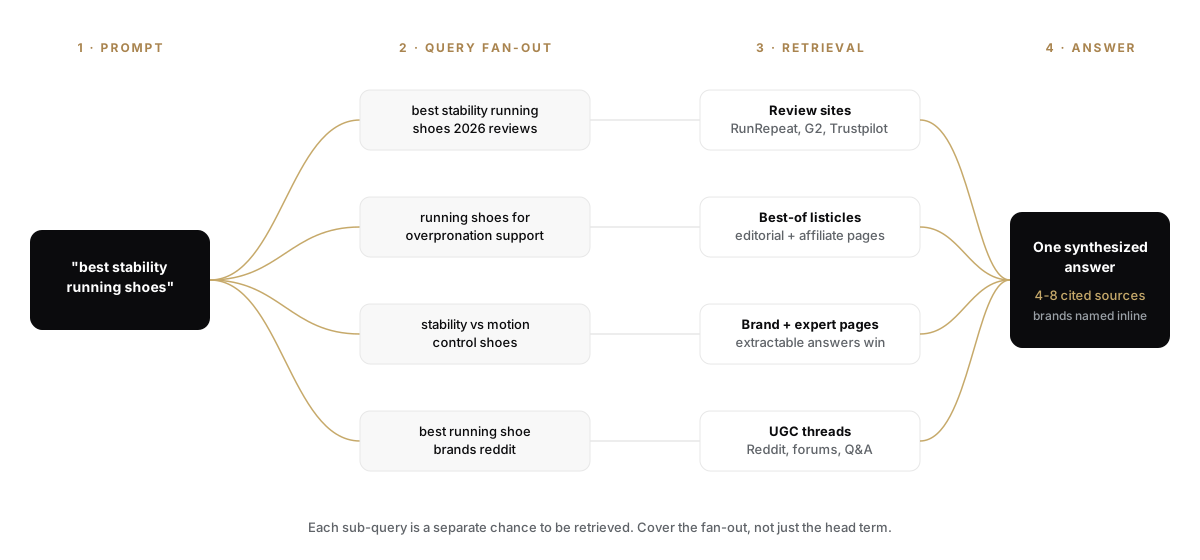
This changes how you plan content. If a buyer asks "best stability running shoes," the model may quietly also search reviews, comparisons, category explainers, and community threads. Every one of those sub-queries is a separate chance for your pages to be retrieved. A site that covers the full question space of its category, the way we build topic clusters around pillar pages, gets far more surface area for citations than a site with one optimized page, even when that one page ranks well for the head term.
The practical rule we follow: map every sub-question your buyers ask to either a section heading or an FAQ entry, and answer it directly in the first 40 to 60 words of that section. The fan-out sections and FAQ in this guide are built exactly that way, on purpose.
Does ChatGPT use Bing or Google?
ChatGPT's live retrieval runs on a mix of third-party search providers and OpenAI's own crawlers, not on Google. ChatGPT Search can use third-party search providers, while OpenAI also relies on its own crawlers, especially OAI-SearchBot, to surface websites in ChatGPT search results. OpenAI also notes that ChatGPT Search for Enterprise and Edu may share disassociated queries with the Bing search engine to return web results. Independent analyses, including work by Seer Interactive, have found heavy overlap (often cited around 87%) between ChatGPT's citations and top Bing results for the same queries.
If Bingbot or OAI-SearchBot cannot crawl, access, render, or understand your site, your content may be excluded from the live-retrieval path even if the page itself is high quality. OpenAI's Publishers and Developers FAQ specifically recommends ensuring that OAI-SearchBot is not blocked in robots.txt. That makes technical crawlability a prerequisite for ChatGPT visibility, not just a traditional SEO optimization.
Here is how the signals compare to the Google playbook you already know:
| Signal | Google SEO | ChatGPT (GEO) |
|---|---|---|
| Success metric | Position and clicks | Mention, citation, and recommendation rate |
| Primary retrieval | Google index | Training data plus live retrieval (Bing-linked) and OpenAI crawlers |
| On-page keywords | High importance | Conversational relevance and extractable passages |
| Backlinks | High importance | Moderate; brand mentions often matter more |
| Unlinked brand mentions | Low to moderate | Very high |
| Schema | Helpful | High value for entity clarity and extraction |
| Freshness | Moderate | High; ChatGPT leans toward newer URLs |
| Reviews and UGC | Local and product dependent | High; Reddit is a top cited domain |
The factors that actually influence ChatGPT visibility (in priority order)
Most guides give you a flat list of seven things and let you guess where to start. Here is the order I actually work in with clients, highest leverage first.
1. Off-site mentions and third-party citations (do this first)
This is the highest-leverage lever, so it goes first. ChatGPT recommends what the web agrees on, so your job is to get mentioned consistently across the sources it trusts: review platforms, "best of" listicles, editorial coverage, directories, and community threads. A review profile with real depth (50-plus reviews is a reasonable legitimacy bar, per Ahrefs' guidance) signals a real business. And Reddit matters more than most brands expect: Ahrefs reports Reddit is ChatGPT's single most-cited domain across their analysis of millions of AI responses. You do not spam Reddit; you participate honestly in the threads where your category comes up. The full playbook for this factor is in the off-site section below.
2. Content structured for extraction
Write so a model can lift a clean answer out of your page. Lead each section with a direct, self-contained answer, use question-based headings, and state things plainly ("X is Y"). This is not a style preference, it is measurable: Ahrefs' analysis of citation patterns found content with question marks in headings gets cited at roughly double the rate (about 18% vs 8.9%), and citations cluster heavily in the first third of a page. The dedicated section below breaks this into specific writing rules you can hand to any content team.
3. Entity authority and brand consistency
ChatGPT has to be confident about who you are before it recommends you. Keep your name, description, and category consistent everywhere, use sameAs links to connect your profiles, and earn a legitimate Wikipedia or Wikidata presence if you qualify. Inconsistent or thin entity data is a quiet reason brands never get named.
4. Freshness
AI systems lean toward recent content. Ahrefs' study of 17 million citations across 7 AI platforms found AI cites content that is on average about 25.7% fresher, and that ChatGPT's referenced URLs run hundreds of days newer than the organic Google results for the same queries. Genuinely update your key pages on a 30 to 90 day cycle, and show an accurate last-updated date. Do not fake the date; update the substance.
5. Schema and technical crawlability
Add Article, FAQPage, and Organization or Person schema so machines can parse your content and reconcile your brand entity. Schema does not rank you by itself, but it removes the friction that keeps you from being understood. Confirm you are not blocking the crawlers that feed ChatGPT. Both get full treatment below, with copy-paste code.
6. YouTube and multi-format mentions
This one is buried in most guides, and it should not be: in the Ahrefs study above, YouTube mentions showed the strongest correlation with ChatGPT visibility of any factor tested. Video transcripts, podcast show notes, and webinar recaps are all indexable text that mentions your brand in category context. If your competitors live only in blog posts and you show up in videos, transcripts, and community threads too, you look like consensus.
How do you structure content so ChatGPT can extract it?
Structure content so any single section can be lifted out and still make sense: a question heading, a direct answer in the first sentence or two, then supporting evidence. These are the rules we apply, in rough priority order.
- Lead with the answer (BLUF). Answer the heading's question in the first 40 to 60 words of the section. Context and nuance come after, not before.
- Use question-based headings. Phrase H2s and H3s the way real users ask. Question-mark headings correlate with roughly double the citation rate in Ahrefs' data.
- Write atomic paragraphs. Each paragraph should stand alone if extracted, with the subject named explicitly rather than carried by pronouns from the previous paragraph.
- Name real entities. Brands, products, people, places, and numbers give the model something concrete to anchor and quote. Vague copy does not get cited.
- Front-load the page. Citations concentrate heavily in the early portion of a page (analyses of citation patterns consistently find the first third earns an outsized share). Put your key claims and best data high.
- Keep sections tight. Aim for roughly 120 to 180 words between headings on evaluation content. Long unbroken walls of text are hard to extract from.
- Use comparison tables, lists, and FAQs. Structured formats are the easiest passages for a model to reuse, which is why this guide is full of them.
Here is the difference in practice.
Weak (hard to extract): "When thinking about AI search, there are a lot of factors to consider, and many of them overlap with traditional SEO while others feel newer. In this section we will explore some of those ideas."
Strong (extractable): "Ranking on ChatGPT means being recommended or cited in AI-generated answers for the questions buyers actually ask. It is earned through Generative Engine Optimization (GEO), not a fixed Google-style position. The three levers are training-data presence, live retrieval, and off-site recommendation consensus."
The first paragraph could introduce any topic on the internet. The second one is a complete, quotable answer with named concepts. Write the second kind.
Schema markup examples for ChatGPT visibility
Schema markup helps ChatGPT visibility by making your entity and your answers machine-readable. It will not rank you by itself, but competitors name schema types in prose while almost nobody ships working code. So here is working code. Customize the domain and brand fields, add each block to the relevant page template, and validate before shipping. For the fundamentals, see our practical guide to schema markup.
Organization schema with sameAs ties your brand entity together across the web. Put it on your homepage and about page:
<script type="application/ld+json">
{
  "@context": "https://schema.org",
  "@type": "Organization",
  "name": "SHAY Group",
  "url": "https://shaygroup.co",
  "logo": "https://shaygroup.co/logos/shay-group-logo.svg",
  "description": "SEO and AI search (GEO) consultancy helping brands get cited and recommended in ChatGPT and other AI answers.",
  "email": "steffan@shaygroup.co",
  "sameAs": [
    "https://www.linkedin.com/company/shaygroup",
    "https://www.crunchbase.com/organization/shay-group"
  ]
}
</script>
Article schema with a Person author connects content to a credentialed human, which supports the E-E-A-T signals AI systems lean on:
<script type="application/ld+json">
{
  "@context": "https://schema.org",
  "@type": "Article",
  "headline": "How to Rank on ChatGPT: A Practitioner's Method",
  "datePublished": "2026-05-26",
  "dateModified": "2026-07-18",
  "author": {
    "@type": "Person",
    "name": "Steffan Hernandez",
    "jobTitle": "SEO & AI Search Strategist",
    "url": "https://shaygroup.co/team/steffan-hernandez/",
    "worksFor": { "@type": "Organization", "name": "SHAY Group" }
  },
  "publisher": { "@type": "Organization", "name": "SHAY Group" },
  "mainEntityOfPage": {
    "@type": "WebPage",
    "@id": "https://shaygroup.co/blog/how-to-rank-on-chatgpt/"
  }
}
</script>
FAQPage schema should mirror a visible FAQ section, never invisible content. Each answer works best at 80 to 150 words with the direct answer in the first sentence:
<script type="application/ld+json">
{
  "@context": "https://schema.org",
  "@type": "FAQPage",
  "mainEntity": [
    {
      "@type": "Question",
      "name": "Can you actually rank on ChatGPT like Google?",
      "acceptedAnswer": {
        "@type": "Answer",
        "text": "Not as a fixed position. Ranking on ChatGPT means your brand is mentioned, recommended, or your pages are cited inside a generated answer. Visibility is probabilistic and should be measured as share of voice across repeated prompts."
      }
    }
  ]
}
</script>
HowTo schema fits any step-by-step process you publish, like the measurement protocol later in this guide:
<script type="application/ld+json">
{
  "@context": "https://schema.org",
  "@type": "HowTo",
  "name": "How to measure ChatGPT visibility with share of voice",
  "description": "A repeatable protocol for measuring brand share of voice in ChatGPT answers.",
  "step": [
    { "@type": "HowToStep", "name": "Build a fixed prompt set", "text": "Write 10 to 20 buyer-intent prompts that match how customers ask ChatGPT for recommendations in your category." },
    { "@type": "HowToStep", "name": "Control for personalization", "text": "Run prompts logged out or in a temporary chat with memory off. Record region and date." },
    { "@type": "HowToStep", "name": "Sample repeatedly", "text": "Run each prompt at least 10 times. Increase the sample when brand lists vary heavily between runs." },
    { "@type": "HowToStep", "name": "Log and score", "text": "Record which brands appear and in what order. Share of voice equals your appearances divided by total runs." },
    { "@type": "HowToStep", "name": "Re-measure monthly", "text": "Repeat the same protocol on a fixed cadence and compare deltas after each optimization sprint." }
  ]
}
</script>
Validate every block with the Schema Markup Validator and, for types Google surfaces, the Rich Results Test. Broken JSON-LD is worse than none.
Technical prerequisites: Bing, crawlers, and Cloudflare
None of the content work matters if the retrieval pipeline cannot reach you. Four checks, in order.
Set up Bing Webmaster Tools
Because ChatGPT's live retrieval leans on a Bing-linked index, Bing indexation is a baseline requirement, and it is the single most skipped step we see in audits. It takes about fifteen minutes:
- Go to Bing Webmaster Tools and sign in.
- Import your site directly from Google Search Console (fastest path, verification carries over) or add your site manually and verify by DNS record or meta tag.
- Submit your XML sitemap under Sitemaps.
- Check Site Explorer for crawl errors and excluded pages; fix anything blocking your money pages.
- Use URL Inspection on your most important pages to confirm they are indexed, and request indexing for the ones that are not.
- Recheck after major content updates. Bing recrawling your updated page is literally the mechanism that refreshes what ChatGPT can retrieve.
Know your crawlers, then open the door
Four user-agents matter, and they do different jobs:
| User-agent | Role | If blocked |
|---|---|---|
OAI-SearchBot | OpenAI's search indexing crawler | Hurts live ChatGPT Search retrieval |
ChatGPT-User | On-demand fetch when a user's chat needs your page | Blocks live browsing fetches |
GPTBot | Training data crawler | Affects future model training, not the same as search |
Bingbot | Bing's index, upstream of much ChatGPT retrieval | Major retrieval risk |
Note the distinction: blocking GPTBot is a training-data policy decision, but blocking OAI-SearchBot or Bingbot removes you from live retrieval. They are separate crawlers with separate rules. A robots.txt that welcomes all of them looks like this:
# OpenAI search and live-fetch crawlers
User-agent: OAI-SearchBot
Allow: /

User-agent: ChatGPT-User
Allow: /

# OpenAI training crawler (block separately if your legal team requires a training opt-out)
User-agent: GPTBot
Allow: /

# Bing powers much of ChatGPT live retrieval
User-agent: Bingbot
Allow: /

# Other AI search crawlers worth allowing
User-agent: ClaudeBot
Allow: /

User-agent: PerplexityBot
Allow: /
Check your live file at yourdomain.com/robots.txt, and test it with a robots.txt validator, my longtime favorite. Crawler policies change, so confirm agent names against OpenAI's crawler documentation before you ship.
Audit Cloudflare's AI bot controls
If you use Cloudflare, check that its AI bot controls are not silently blocking these crawlers. Starting September 15, 2026, Cloudflare is setting new defaults that block Training and Agent crawlers on ad-bearing pages for new domains. The part that matters most for GEO: multi-purpose crawlers that combine Search with Training (including Bingbot) will be blocked for any customer who has enabled Training blocking, whether through the newer AI traffic controls or the legacy Block AI Bots toggle. Since ChatGPT uses Bingbot for live retrieval, silently blocking it cuts off your content from the live-retrieval path regardless of how well your page is optimized.
The checklist: open your Cloudflare dashboard, go to the AI Crawl Control (or AI bot) settings, and confirm that Search-category crawlers including Bingbot and OAI-SearchBot are allowed. If anyone has ever clicked "Block AI Bots" on your zone, assume the worst and verify.
Add an llms.txt file
llms.txt is an emerging, openly documented standard: a plain markdown file at your domain root that tells AI systems what your site is and which pages matter most. Adoption by the AI platforms is still uneven, so treat it as a low-cost hedge rather than a ranking lever. It takes ten minutes:
# SHAY Group

> SHAY Group is an SEO and Generative Engine Optimization (GEO) consultancy
> helping brands get cited and recommended in ChatGPT and other AI answers.

## Priority pages

- [How to Rank on ChatGPT](https://shaygroup.co/blog/how-to-rank-on-chatgpt/): Practitioner method for ChatGPT visibility
- [GEO & AEO Services](https://shaygroup.co/services/geo-aeo/): AI search optimization services
- [About](https://shaygroup.co/about/): Company entity and contact information
One more technical warning: AI crawlers are worse at JavaScript than Googlebot. If your critical content only exists after client-side rendering, assume the retrieval pipeline sees a blank page. Server-render or statically generate anything you want cited. If you are not sure what your site serves to crawlers, that is exactly what a technical SEO audit is for.
The off-site playbook: mentions that actually get cited
Off-site mentions are the highest-leverage factor, so they deserve more than a bullet point. This is the operating playbook we run, roughly in the order we run it.
- Build review depth first. Get past 50 genuine reviews on the platforms that matter for your category: G2 or Capterra for software, Trustpilot and Google for consumer and local, niche platforms for everyone else. Review depth is a legitimacy bar the model appears to respect, and it compounds slowly, so start now.
- Get on the best-of lists ChatGPT already cites. Run your buyer prompts and note which listicles ChatGPT cites, then work the list. Pitch the publishers of those exact pages with a reason to include you: original data, a genuinely differentiated offer, or an affiliate relationship where appropriate. When no good list exists for your niche, pitch the creation of one to a relevant publisher. That is a stronger play than begging for edits to a crowded page.
- Participate on Reddit honestly. Find the threads ChatGPT is already citing (they show up in its citations, and a Bing or Google search for your category plus site:reddit.com surfaces the rest). Answer questions thoroughly without pitching, and mention your brand only where it genuinely answers the question. Astroturfing gets detected by moderators and, increasingly, by the models themselves.
- Earn YouTube mentions. Publish videos on your own channel with clean transcripts, and sponsor or collaborate with creators your buyers already watch. Remember, YouTube mentions were the single strongest correlated factor in the Ahrefs study. Podcast appearances with published show notes do a similar job.
- Do digital PR and expert commentary. Respond to journalist requests through Connectively (formerly HARO), Qwoted, and industry publications. One quoted expert comment in a trade publication is an unlinked brand mention in exactly the category context the model needs. Our approach to digital PR and link building covers this in depth.
- Wikipedia and Wikidata, only if you qualify. A legitimate Wikipedia presence is a strong entity signal, but only pursue it if you genuinely meet notability guidelines. A rejected or deleted page is worse than none. A Wikidata entry has a lower bar and is worth having either way.
- Run a mention-gap analysis. List the pages and domains that cite or mention your competitors but not you. You can do this manually from your prompt logs (note every source ChatGPT cites when it recommends a competitor), or at scale with tools like Ahrefs Brand Radar. That list, sorted by how often each source gets cited, is your outreach queue for the next quarter.
If this list looks like brand marketing and PR wearing an SEO hat, that is exactly what it is. The web's opinion of you is now a ranking factor you can operate on. This is the bulk of what our GEO and AEO engagements actually do day to day.
How to measure your ChatGPT visibility (a repeatable method)
You cannot check a single ranking, so you measure share of voice across repeated runs. This is the protocol we use, and it costs nothing but time.
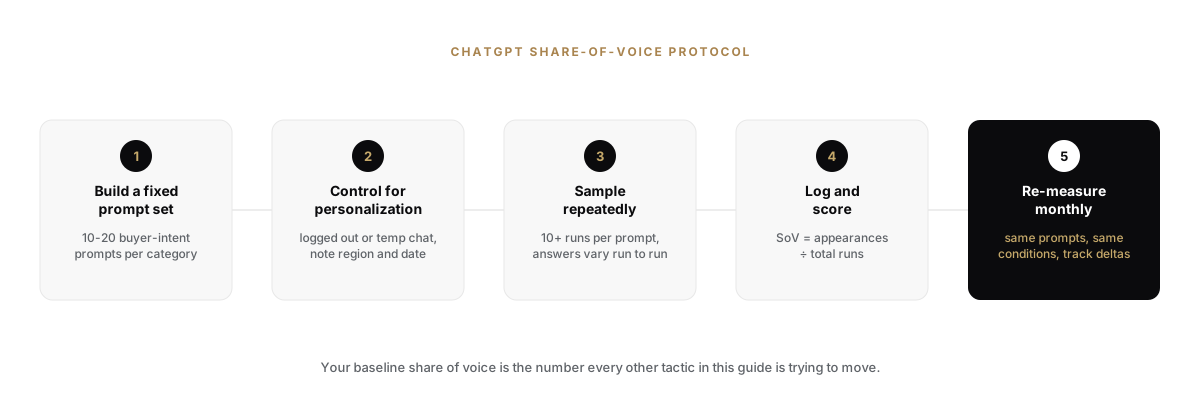
- Build a fixed prompt set. Write buyer-intent prompts for your category, the way a real customer would ask. For a mattress retailer, that is prompts like "best mattress store in the Bay Area" or "where should I buy a mattress near San Jose." Start with 3 to 5 if you are doing this by hand; a serious program should run 10 to 20 per category. Question-mining tools like AlsoAsked and AnswerThePublic help you find phrasings you would not guess.
- Run each prompt multiple times. ChatGPT is probabilistic. SparkToro found that if you ask ChatGPT the same thing 100 times, there is less than a 1-in-100 chance any two answers return the same brand list. A single check is noise. Run each prompt at least 10 times to see the pattern; scale up to 20 or more when the brand list shifts a lot between runs.
- Control for personalization. Run logged out, or in a temporary chat with memory off, and note your region and the date. This is the step that separates a real reading from a flattering personalized answer.
- Log and score. Record which brands appear and in what order, then compute a simple share-of-voice score: your appearances divided by total runs. Grade the quality too: was your brand merely mentioned, cited with a link, or recommended positively? A spreadsheet with columns for prompt, run number, brands returned, and your position is all you need.
- Re-measure on a cadence. Re-run the same set under the same conditions on a fixed schedule (monthly works for most clients) so you can see movement instead of guessing. Compare deltas after each optimization sprint, and run the same prompts for 3 to 5 competitors so your number has context.
The manual, logged-out method sets an honest baseline and controls for personalization, and it stays free, but it does not scale to a monthly client report. We operationalize ongoing tracking with Semrush's AI Brand Performance reports, which show how AI platforms describe, position, and talk about a brand across the prompts that matter most in a category. Profound and Ahrefs Brand Radar do similar work; we pick per client based on budget and coverage. The tool changes the effort, not the logic: it is the same share-of-voice question, measured continuously.
Track AI referrals in GA4
Share of voice measures whether you appear in answers. GA4 measures whether those appearances send anyone to your site. Build a simple exploration or custom report filtered to sessions where the referral source contains chatgpt.com, perplexity.ai, gemini.google.com, or copilot.microsoft.com, and watch it monthly alongside your SoV number. Two caveats: AI referral traffic understates real impact because many answers never produce a click, and a rising branded-search trend is often the clearer footprint of AI exposure. We wire this into client dashboards as part of our analytics and reporting work.
The tool stack
Start manual, then add tooling when you need scale. What we actually use, grouped by job:
| Tool | Job | Cost |
|---|---|---|
| ChatGPT (logged out / temp chat) | Manual multi-run prompt testing | Free |
| Bing Webmaster Tools | Indexation, sitemaps, crawl errors | Free |
| Google Search Console | Traditional SEO parity and sitemap hygiene | Free |
| Schema Markup Validator | Validate JSON-LD | Free |
| GA4 | AI referral traffic | Free |
| Semrush AI Brand Performance | Cross-prompt brand tracking at scale | Paid |
| Ahrefs Brand Radar | Mentions, citations, mention gaps | Paid |
| Profound | Enterprise AI visibility tracking | Paid |
| AlsoAsked / AnswerThePublic | Question mining for prompt sets and fan-out coverage | Freemium |
Do not buy a paid tracker before you have run the manual protocol at least once. The manual run teaches you what the numbers mean.
What this looks like on a real account
A multi-location mattress retailer came to us focused entirely on Google rankings while ChatGPT quietly answered "where should I buy a mattress near me" style questions for their market without ever naming them. We ran the exact program in this guide. We started with a baseline: a fixed set of buyer-intent prompts, each run logged out several times, which confirmed their brand was effectively absent from the answers while two national competitors showed up in most runs.
The first month was foundation work: Bing Webmaster Tools setup (they had never verified), a robots.txt and Cloudflare audit that turned out to be blocking Bingbot on two location subdomains, and Organization plus location schema. Months two through four were the off-site push: a review velocity program across Google and Yelp, outreach to the regional "best mattress store" listicles ChatGPT was already citing, and honest participation in the local subreddits where mattress questions came up.
Over the following months, share of voice on the fixed prompt set climbed from that near-absent baseline to a regular presence in local recommendation answers, and GA4 began recording AI referral sessions from ChatGPT where there had been none. The point is not a specific headline number, and we will not dress this up with figures we cannot show you; every market differs. The point is that nothing in the program was exotic. It was measurement, crawl access, extraction-friendly pages, and a steady off-site drumbeat, in that order.
How long does it take to rank in ChatGPT?
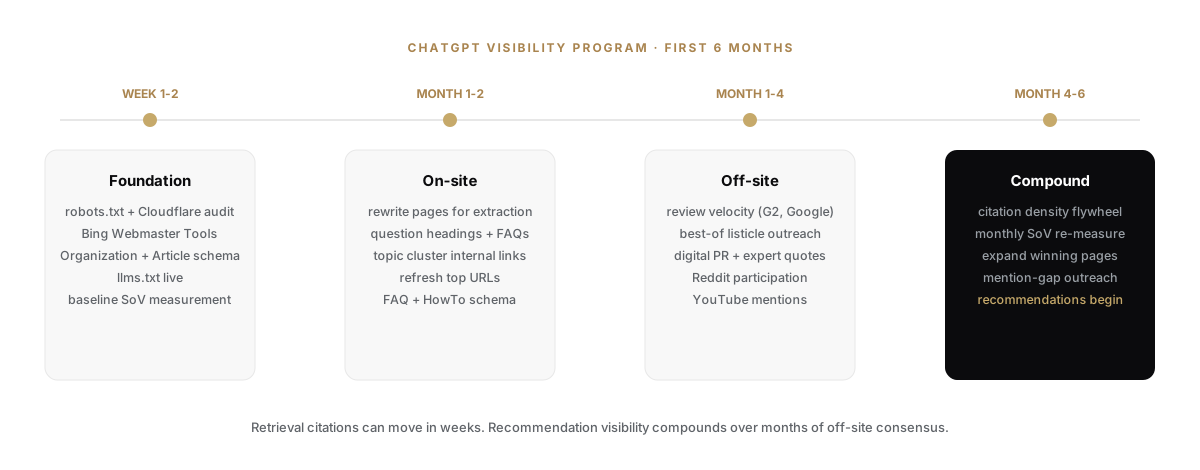
It depends on which lever you pull. Retrieval-based visibility (from new or updated, crawlable content) can show up in weeks. Recommendation-based visibility (which depends on off-site authority and, eventually, training data) usually takes months, because it depends on the wider web catching up to how you describe yourself.
The reason the ranges are so different is the mechanism. Live retrieval only needs Bing to recrawl your updated page. Being recommended needs enough third parties to mention you consistently that the model treats it as consensus. There is no guaranteed timeline, and anyone promising one is guessing. What we watch for is the order of events: crawlable content that we update tends to reappear in retrieval-based answers first, and unprompted category recommendations follow once the off-site signals accumulate.
Here is how a realistic first six months sequences:
| Phase | Window | Focus |
|---|---|---|
| Foundation | Week 1-2 | robots.txt and Cloudflare audit, Bing Webmaster Tools, core schema, llms.txt, baseline share-of-voice measurement |
| On-site | Month 1-2 | Rewrite key pages for extraction, add FAQs, build topic cluster internal links, refresh top URLs |
| Off-site | Month 1-4 | Review velocity, best-of listicle outreach, digital PR, Reddit participation, YouTube mentions |
| Compound | Month 4-6 | Monthly SoV re-measurement, expand winning pages, mention-gap outreach, citation flywheel |
How is ChatGPT different from Perplexity, Gemini, and Claude?
The fundamentals transfer, but each engine has its own retrieval bias, so check where your buyers actually ask before you specialize:
| Engine | Retrieval bias | Extra emphasis |
|---|---|---|
| ChatGPT | Bing-linked index plus OpenAI crawlers and consensus | Mentions, reviews, YouTube, extractability |
| Perplexity | Aggressive live web retrieval | Reddit, community sources, freshness |
| Google AI Overviews | Google's organic index | Traditional SEO still strongly correlated (our guide) |
| Gemini | Google ecosystem | Entity data, traditional rankings |
| Claude | Selective web search | Authority and clarity of sources |
| Copilot | Microsoft ecosystem | Bing alignment, same foundation as ChatGPT |
The good news: the program in this guide (crawl access, extractable content, entity consistency, off-site mentions, measurement) is the shared foundation for all of them. Optimize for ChatGPT first if that is where your buyers are, and track the others with the same prompt set so you see divergence early.
Common mistakes that keep brands out of ChatGPT
- Checking one prompt once and calling it a ranking. It is probabilistic and personalized. Use the protocol above.
- Ignoring Bing. No Bing Webmaster Tools, no sitemap submitted, no idea whether Bing indexes the site. For ChatGPT, Bing is not optional.
- Keyword stuffing. It reads as unnatural to the model and measurably lowers citation probability. Write for the reader.
- Publishing thin AI content at scale. Volume does not help; Ahrefs found page count has an extremely low correlation with AI visibility. Depth and consistency win.
- Covering only the head term. One optimized page cannot catch a fan-out. Cover the sub-questions around your category or lose those retrievals to whoever does.
- Naming schema types without shipping code. A blog post that says "use FAQ schema" changes nothing. Validated JSON-LD in your templates does.
- Blocking the AI crawlers.
GPTBot,OAI-SearchBot, andChatGPT-Userblocked in robots.txt (or by Cloudflare) means you are invisible to live retrieval. - Inconsistent brand data. If your name, category, and description differ across the web, the model cannot form a confident entity, so it stays quiet about you.
Frequently asked questions
Can you actually rank on ChatGPT the same way you rank on Google?
No. ChatGPT does not assign fixed positions; it mentions or cites brands probabilistically based on training data and live retrieval. Ranking here means being recommended or cited often and consistently for your category, which you influence through off-site mentions, extractable content, and entity authority. Measure it as share of voice across repeated prompts, not as a position you can refresh.
Does ChatGPT use Bing or Google for search?
ChatGPT Search uses a mix of third-party search providers and OpenAI's own crawlers, especially OAI-SearchBot, and its enterprise documentation names Bing as a web results provider. It does not retrieve from Google. Practically, that means Bing indexation and Bingbot crawl access are baseline technical requirements for ChatGPT visibility, and Bing Webmaster Tools is the console to watch.
What is the difference between GEO, AEO, and LLMO?
They largely describe the same discipline from different angles. GEO (generative engine optimization) is the umbrella practice of earning visibility in AI-generated answers. AEO (answer engine optimization) emphasizes structuring content so answer engines can extract and quote it. LLMO frames the work around large language models specifically. If a vendor sells you all three as separate services, ask what actually differs.
How long does it take to appear in ChatGPT answers?
Retrieval-based citations from crawlable, updated pages can appear within weeks of Bing recrawling them. Recommendation-based visibility, where ChatGPT names your brand unprompted, usually takes months because it depends on off-site consensus: reviews, listicles, editorial mentions, and community discussion accumulating around your brand. Anyone promising a guaranteed timeline is guessing.
How do I check if ChatGPT is mentioning my brand?
Build a fixed set of buyer-intent prompts, run each one at least 10 times logged out or in a temporary chat with memory off, and log which brands appear and in what order. Your appearances divided by total runs is your share of voice. Re-measure monthly under the same conditions. Tools like Semrush AI Brand Performance, Ahrefs Brand Radar, or Profound automate the same measurement at scale.
Which schema types help ChatGPT visibility?
Organization, Person, Article, FAQPage, and HowTo are the core set. They help machines parse your entities and lift clean answers from your pages. Schema alone does not rank you, but it removes parsing friction and strengthens entity reconciliation, and a majority of pages cited by AI engines in several studies carry structured data. Ship validated JSON-LD, not just schema names in a strategy deck.
Should I block GPTBot?
Only if you have a deliberate training-data policy that requires it. GPTBot is OpenAI's training crawler; blocking it does not block ChatGPT Search. The dangerous mistake is the reverse: blocking OAI-SearchBot, ChatGPT-User, or Bingbot, which removes you from live retrieval. Audit robots.txt and Cloudflare AI bot settings so a training opt-out never silently becomes a search opt-out.
Does a Wikipedia page help you rank on ChatGPT?
A legitimate Wikipedia page is a meaningful entity signal, and Wikipedia content is heavily represented in training data. But only pursue it if you genuinely meet notability guidelines; a rejected or repeatedly deleted article helps nobody. A Wikidata entry has a lower bar and still supports entity reconciliation. Most brands get more mileage from reviews, listicles, and editorial mentions first.
Do unlinked brand mentions count?
Yes, and this is one of the biggest breaks from traditional SEO. ChatGPT recommendations correlate strongly with how often and how consistently the wider web mentions a brand in category context, with or without a hyperlink. A quoted expert comment, a Reddit thread, or a listicle mention moves the consensus even when no link is attached.
Does traditional SEO still help ChatGPT visibility?
Yes. Crawlability, site quality, structured data, and strong organic rankings all feed the pipeline: Bing's index supplies much of ChatGPT's live retrieval, and independent analyses find heavy overlap between ChatGPT citations and top Bing results. Traditional SEO is necessary but no longer sufficient; the off-site mention layer sits on top of it, not instead of it.
What is llms.txt and should I add it?
llms.txt is an emerging standard: a markdown file at your domain root that describes your site and lists priority pages for AI systems. Platform adoption is still uneven, so treat it as a ten-minute, low-cost hedge rather than a ranking lever. Add it, keep it current, and do not expect miracles from it.
How is ranking on ChatGPT different from Perplexity or Gemini?
The foundation is shared: crawl access, extractable content, entity consistency, and off-site mentions help everywhere. The biases differ. ChatGPT leans on a Bing-linked index, reviews, and YouTube mentions. Perplexity leans harder on live retrieval, Reddit, and freshness. Gemini and Google AI Overviews correlate strongly with traditional Google rankings. Track all of them with the same prompt set and optimize where your buyers actually ask.
The Practical Takeaway
Ranking on ChatGPT is not a trick, it is a method: measure your share of voice honestly, open the technical doors (Bing, crawlers, Cloudflare), structure content so a model can quote it, and put most of your effort where the leverage is, in the off-site mentions that build consensus. It is probabilistic, it is personalized, and it is earned over time.
If you want a clear read on where your brand actually stands in ChatGPT, we will run the measurement baseline with you as the first step of any conversation: get in touch with SHAY Group to talk about our GEO and AEO work. We start with the measurement, not the sales pitch.