
Most law firm practice area pages are brochures: a paragraph of boilerplate, a stock photo, and a "Contact Us" button. Yet these are the pages that decide whether a firm wins the person quietly researching at 11 p.m. after a car accident. This guide gives you the working artifacts to fix that, not another list of tips: an annotated anatomy diagram of a high-converting practice area page, a complete pillar-and-cluster map for a car accident practice, a legal query fan-out model showing how AI systems actually assemble legal answers, a five-step rebuild sequence you can hand to a marketing lead, and the attribution stack that ties a signed client back to a single URL.
I run SEO strategy for law firms and other high-stakes industries, and I have been doing this for over a decade for firms in personal injury, bankruptcy, criminal defense, and family law. The pattern is consistent: the firms that win treat practice area pages as content ecosystems, not brochures. Everything below is the process we run at SHAY Group, published in enough detail that you can execute it without us.
What is a law firm practice area page (and what it is not)
A law firm practice area page is a permanent page dedicated to one legal service that explains the issue in plain English, presents the attorneys who handle it, and gives a prospective client a clear next step. Structurally it is a pillar page: comprehensive on the practice area itself, supported by narrower cluster content that links back to it.
Three page types get confused with it, and the distinction matters because they need different content:
- A landing page is built for one paid or campaign traffic source and optimized for a single conversion event. It is often noindexed and intentionally thin outside the offer.
- A location page is a geo-targeted variant of a practice area page, built to compete for "car accident lawyer in [city]" queries. It should differ on local substance, not just the city name.
- A cluster page is informational content answering one narrow question inside the practice area. It exists to capture research-stage searches and pass authority up to the pillar.
Because legal queries fall into what Google calls Your Money or Your Life (YMYL) topics, subjects that can materially affect a person's finances, safety, or legal standing, Google applies its strictest quality standards to all of them. A practice area page with three sentences of generic copy fails that test. One that explains the legal issue clearly, answers the questions a worried prospect actually has, includes real case results with bar-compliant disclaimers, and shows a credentialed attorney standing behind the words passes it.
"Working with an injury law firm client, the biggest wins didn't come from publishing more blog posts. They came from rebuilding the practice area pages those posts should have been supporting. Most firms have the content backwards: a busy blog orbiting an empty money page."
What does a high-converting practice area page look like?
A high-converting practice area page has eight distinct zones, each doing a specific job: hero and intake path, plain-English explainer, results and proof, jump navigation, in-depth content, named attorney block, FAQ block, and related cluster links. Most firms build two or three of them and wonder why the page does not convert.
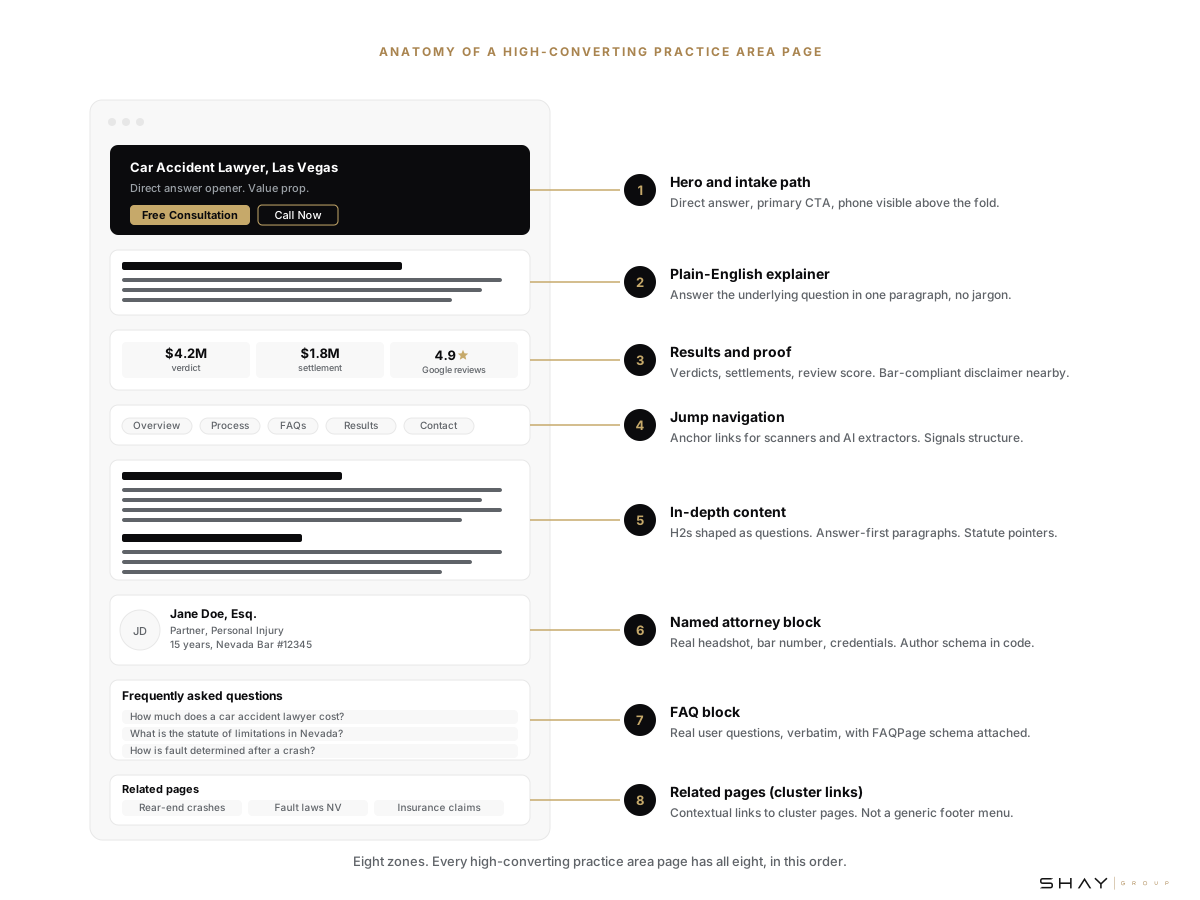
Zone 1: Hero and intake path. The H1 names the service and the market. Directly under it, one sentence that answers the reader's underlying question rather than describing the firm. The phone number and the primary call to action are both visible without scrolling. A convinced visitor should never have to hunt for the next step.
Zone 2: Plain-English explainer. One paragraph describing the legal issue and how your firm helps, with no legalese and no statutory citations. Your prospect is a stressed non-expert, not opposing counsel. This is also the passage most likely to be extracted for a featured snippet or an AI answer, which is a second reason to keep it clean.
Zone 3: Results and proof. Verdicts, settlements, and your review score, with the bar-compliant disclaimer adjacent rather than buried in a footer. Concrete outcomes are the fastest way to demonstrate the Experience half of E-E-A-T.
Zone 4: Jump navigation. Anchor links to the sections below. This helps people scanning on a phone, and it gives crawlers and AI extractors an explicit map of what the page covers.
Zone 5: In-depth content. H2s shaped as the questions people actually ask, each opening with a direct answer, each pointing at the relevant statute or procedure by name. This is the bulk of the page and the reason it can rank for more than one query.
Zone 6: Named attorney block. A real headshot, bar number, admissions, and years in practice, linked to a full bio, with Author schema in the code. Anonymous legal content signals nothing to a reader or to a quality rater.
Zone 7: FAQ block. The questions prospects ask at intake, in their words, with FAQPage schema attached. These are your highest-probability snippet and AI citation targets.
Zone 8: Related cluster links. Contextual links to the cluster pages that support this pillar, placed in the sections where those subtopics come up. Not a generic footer menu, and not an automated related-posts widget.
How do you build topical authority for a law firm?
You build topical authority by covering one practice area from every angle a prospect might approach it from, then connecting those pages with deliberate internal links. One long page will not do it. The structure that works is the pillar-and-cluster model applied directly to your practice areas.
Topical authority is Google's assessment of how comprehensively and credibly your site covers a subject. The pillar is the practice area page: comprehensive, authoritative, the definitive resource on that service. The cluster is the set of supporting pages that each answer a narrower question inside the topic. Each cluster page links up to the pillar with descriptive anchor text. The pillar links down to the clusters most relevant to each of its sections.
Here is a complete, usable cluster map for a car accident practice, organized into the three intent bands that matter: legal process, damages and money, and case-type long-tail.
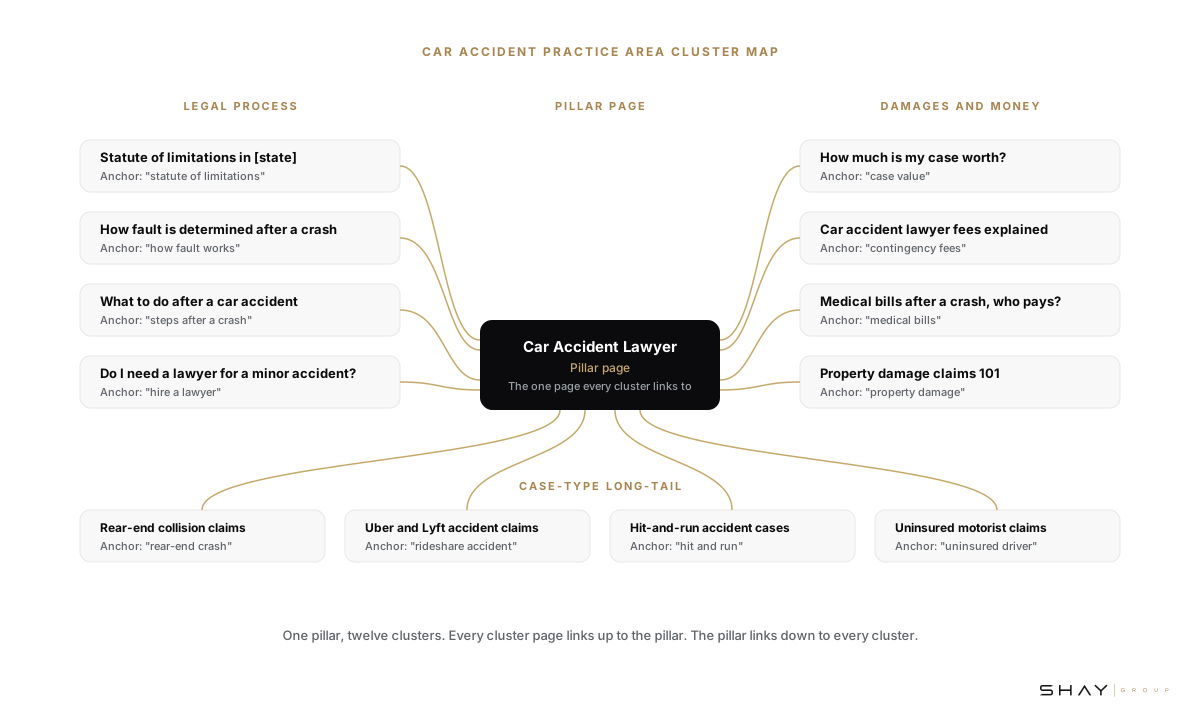
The state-specific pages use a bracketed placeholder deliberately. Statutes of limitations, damages caps, and comparative fault rules differ enough by state that the page has to be written for one jurisdiction, not templated across fifty.
Two things happen at once when this is built properly. For readers, whatever question brought them in, there is a page that answers it and a clear path to a consultation. For search engines and AI systems, dense internal linking plus comprehensive coverage signals that your firm genuinely owns the topic. A single blog post competes for one keyword. A well-built cluster competes for the entire topic and lifts the pillar with it.
How do we build topic clusters around practice area pages?
The pillar-and-cluster model is the concept. This is the actual three-part process we run, using Ahrefs and Semrush for query discovery, Google Search Console for the firm's own query data, and a shared sheet as the cluster map of record.
Step 1: Deep keyword research, mapped to intent
We do not start with a blog calendar. We start by pulling every query the practice area can realistically own: seed terms, long-tail variations, question queries from People Also Ask, autocomplete, intake call notes, and competitor gap analysis. Then each keyword gets classified by intent:
- Transactional ("car accident lawyer near me") maps to the pillar or a geo page.
- Informational ("what to do after a rear-end collision") maps to a cluster article.
- Comparative ("settle vs. sue after a car accident") maps to decision-stage cluster content that sits closest to the consultation.
Every keyword ends up assigned to exactly one page. No two pages compete for the same term, which is how you prevent the cannibalization that quietly caps most law firm sites.
Step 2: Query fan-out
When someone asks ChatGPT, Gemini, or Google's AI Mode a legal question, the system does not run one search. It fans the question out into related sub-queries, retrieves passages for each, and synthesizes an answer. Different sub-queries pull from different source types, which is why a firm page alone rarely wins the whole answer.
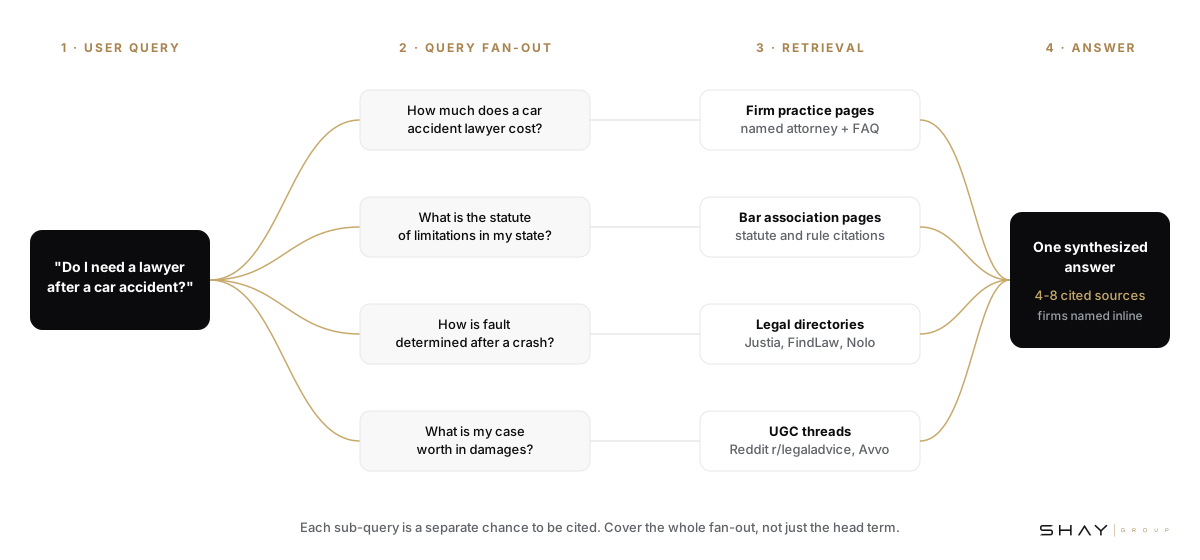
So we work it in reverse: take each head query, expand it into the full set of sub-questions a searcher or an AI system would need answered (deadlines, costs, fault, evidence, process, outcomes), and make sure every sub-question has a dedicated section or a dedicated cluster page. If the fan-out surfaces a question your site does not answer, that is a content gap and it goes in the build queue.
Step 3: Targeted internal linking
Internal links are where most clusters fail. Random related-post widgets do not build authority. Deliberate, directional links do. Our rules:
- Every cluster page links up to its pillar with descriptive, keyword-relevant anchor text, never "click here" or "learn more."
- The pillar links down to its most important cluster pages from the sections where those subtopics naturally come up.
- Cluster pages cross-link to each other only when the topics genuinely connect. A page on filing deadlines links to a page on claim value, not to an unrelated practice area.
- Anchor text is varied but specific, so each link reinforces what the target page is about without looking manipulated.
- Orphans get fixed on a schedule. Any page with no internal links pointing to it is either linked into the cluster or cut.
The result is a site structure where authority flows toward the pages that produce consultations, and where both crawlers and AI systems can trace how your content fits together. That structure is the difference between a blog and a cluster.
How do you show E-E-A-T on a legal practice area page?
You show E-E-A-T on a legal page with specific on-page elements, not with an About page: a named attorney with a visible bar number and a linked bio, real case results with disclaimers, current statutory references, and third-party corroboration of the firm's standing. Because legal content is YMYL, Google's quality raters explicitly evaluate Experience, Expertise, Authoritativeness, and Trustworthiness here.
- Experience. Real case results, verdicts, and settlements (with bar-compliant disclaimers), plus specific examples of handling the exact situation the reader faces.
- Expertise. Content attributed to a named attorney with visible credentials: linked bio, bar admissions, relevant background. Anonymous copy signals nothing.
- Authoritativeness. Reputation beyond your own site: earned links from reputable legal directories and publications, consistent mentions, credible presence. Authority is cumulative.
- Trustworthiness. Accurate, current information. Transparent authorship. Genuine reviews with review schema markup. A secure site, clear contact information, and claims that stay compliant with your state bar's advertising rules.
The fifteen-minute E-E-A-T audit. Open any practice area page and check: Is there a named author with a linked bio? Does that bio show a bar number and admissions? Is there at least one real case result with a disclaimer nearby? Is every statute or deadline referenced still current? Is Author schema present in the code, and does the name in it match the byline? Are reviews real and marked up? Does any claim on the page use "specialist," "expert," or "best" in a way your state bar restricts? A no on any of these is a fixable gap.
On the code side, three schema types carry most of the weight: Article with a real author entity, FAQPage on the FAQ block, and Organization or LegalService for the firm. Schema does not create authority, but its absence forfeits an easy signal.
One glaring error, an outdated statute, a broken link, a sloppy typo, can make a prospect and Google view you as less credible than the competitor one result down. On legal pages, trust is not a nice-to-have. It is the ranking factor.
How do you win AI Overview citations for legal queries?
You win AI Overview citations for legal queries by writing question-mirroring headings with answer-first openers, naming the statutes and procedures involved, attributing the page to a credentialed attorney, and citing a primary source such as a state bar rule. Domain strength helps but is clearly not the deciding factor.
When we read the live AI Overview for "law firm practice area pages" in July 2026, the cited sources were not dominated by the biggest domains. They included two YouTube videos, two state bar association pages, three legal marketing agency articles, and one web design portfolio. That mix tells you what the system is rewarding: clear structure, demonstrable authority, and format variety. A mid-size firm can compete in that set.
The checklist we run against every legal page we want cited:
- Question-mirroring H2s. The heading should read like the query, not like a chapter title.
- Answer-first openers. One or two sentences directly under the heading that fully answer it. This is the citable unit.
- Named entity coverage. Statutes, courts, filing procedures, agencies, and damages rules mentioned by name. Vague pages do not get cited on legal topics.
- Credentialed author schema. A real attorney, a live bio page, a bar number.
- FAQPage and Article schema that validate, with the FAQ questions also present in the visible page.
- Outbound citation to a primary source, typically the state bar or the statute itself.
- A visible last-updated date on a page that has genuinely been updated.
- Format variety in the cluster. If video and bar-association pages are being cited for your topic, a text-only cluster is competing with one hand tied.
The pillar-and-cluster structure above is naturally friendly to AI Overviews, ChatGPT, Perplexity, and Gemini because it answers discrete questions cleanly, one per page. Earning those citations is GEO, or generative engine optimization, and most firms have not shown up to it yet.
"My rule is simple: if a page can't earn a citation in an AI answer, it won't hold a position in traditional search for long. The two systems are converging on the same standard, clear answers from credible, named experts. Build for that standard once and you win both surfaces."
A caveat on producing legal content with AI: unedited AI output is a liability on legal pages. It can be inaccurate, generic, or drift into giving legal advice. Every piece must be reviewed by a qualified attorney, kept strictly informational, and checked against state bar rules. As a drafting assistant under attorney review, AI is a force multiplier. Published unchecked, it is an accuracy and ethics risk that undoes everything else in this guide.
How should multi-location firms handle geo-targeted pages?
Multi-location firms should build a geo page only where the market genuinely differs, and the page must carry that difference in substance. Firms serving multiple cities need location-specific content, and this is where most of them create duplicate-content problems instead of rankings.
What actually differs city to city, and therefore what belongs on a geo page:
- Local court procedures and venue. Which courthouse, which filing rules, typical scheduling.
- State or county statutory quirks. Deadlines, damages caps, comparative fault rules, no-fault thresholds.
- Jury tendencies and settlement norms in that venue, where you can speak to them from experience.
- Local institutions that appear in these cases: hospitals, trauma centers, police departments, insurers with a heavy local presence.
- Attorneys who actually practice in that market, named on the page.
If you cannot fill three of those five with real substance, do not build the page. For firms with many locations, systematize it with a template that forces meaningful local differentiation rather than one that permits a city-name swap.
"I've managed local SEO for multi-location clients not just in legal, but also in professional services, retail, and real estate, and the failure mode is identical: 50 pages that are 95% the same. Google discounts them, and so do the people reading them. If the only thing that changes is the city name, you built one page 50 times, not 50 pages."
How often should a law firm update a practice area page?
Annually as a floor, and immediately when a relevant statute, procedural rule, or damages cap changes. Legal content decays in a way most content does not: a page that was accurate three years ago can quietly mislead a reader today, and both readers and Google notice.
The cadence we recommend by area of law, based on how often the underlying rules and figures actually move:
| Practice area | Review cadence | What usually triggers an off-cycle update |
|---|---|---|
| Personal injury | Every 6 months | Damages caps, comparative fault changes, insurance minimums |
| Criminal defense | Every 6 months | Sentencing guideline changes, new case law, statute amendments |
| Family law | Annually | Custody or support guideline revisions, filing fee changes |
| Immigration | Quarterly | Policy memos, fee schedules, processing time shifts |
| Estate planning | Annually | Estate tax thresholds, probate rule changes |
| Business and employment | Annually | Wage rules, classification standards, new compliance deadlines |
Republish and resubmit the URL for indexing after substantive updates, and stamp a real last-updated date. On YMYL legal topics, currency is a direct trust signal, and stale content erodes the exact E-E-A-T you spent months building. Content-refresh programs are usually the highest-leverage, lowest-cost move in a legal content budget.
How do you measure practice area page ROI?
You measure practice area page ROI in consultations and cost per consultation, attributed to a specific URL, not in traffic. That attribution has to be engineered before you publish, because you cannot retrofit it.
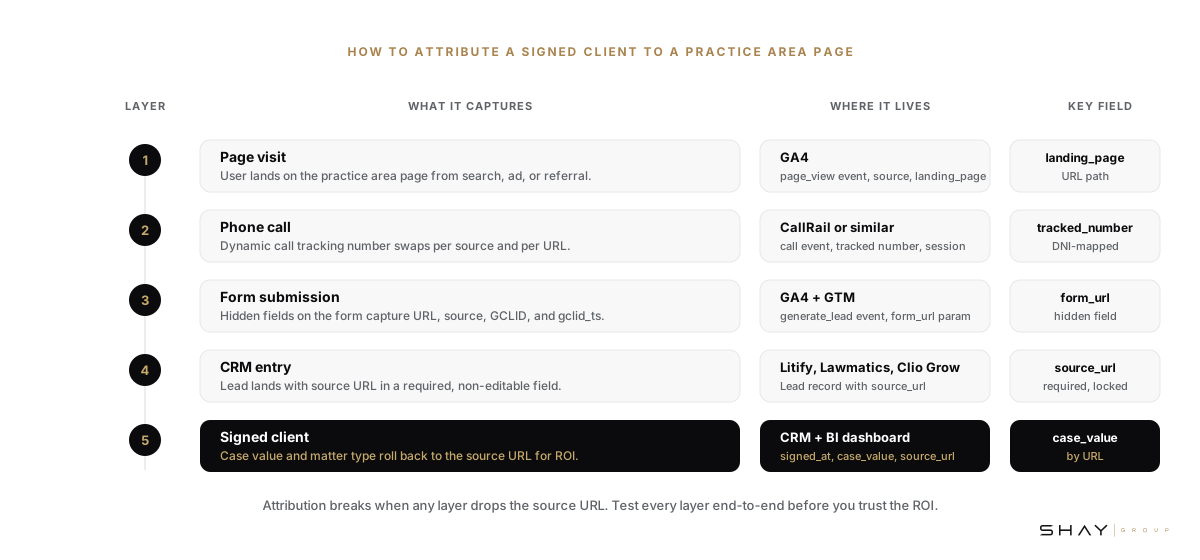
The stack only works because every layer carries the same key: the landing page URL. Dynamic number insertion maps a tracked phone number to the source and URL. Your form pushes a hidden form_url field into the generate_lead event. Your CRM makes the source URL a required, non-editable field on the lead record. When the case is signed, case_value and source_url sit on the same record, and the dashboard can finally answer which page produced revenue.
With that in place, measure four things in this order:
- Consultations and qualified leads attributed to organic content. This is the metric that connects to revenue. Everything else is diagnostic.
- Cost per consultation, organic versus paid. Legal keywords carry some of the highest costs per click in all of paid search, and high-intent injury and mass tort terms in competitive metros are among the most expensive anywhere. Every consultation your content earns organically is one you did not pay that rate for, and organic compounds instead of resetting to zero when you pause spend.
- Keyword rankings and AI citations for priority practice area and local terms. Are you gaining ground on the queries that actually produce cases, in both traditional results and AI answers?
- Organic traffic to practice area pages and clusters. Useful as a leading indicator, meaningless as a goal.
The break-even question, as a formula. Divide the fully loaded cost of the rebuild by your average case value multiplied by your consultation-to-signed rate. The result is how many organic consultations the page has to produce to pay for itself. Use your own numbers from the CRM, not benchmarks. Published cost-per-click figures for legal terms vary by an order of magnitude between markets and rarely reflect what you would actually pay, so pull real numbers for your market with a PPC strategist before you build a comparison on them.
Set up GA4 and conversion tracking so consultations are attributed to specific pages and clusters before you publish anything. Measure to the consultation, and the ROI case makes itself.
What are the most common mistakes on law firm practice area pages?
These are the eight failures we find in nearly every legal site audit, in rough order of how much they cost:
- An umbrella page covering twenty practices. One page cannot be the authoritative answer for twenty different services. Split it, one page per service you actively pursue.
- A busy blog orbiting an empty money page. Dozens of posts, no substantive pillar for them to point at, and no consultations.
- City-swap duplicates. Fifty geo pages where the only variable is the city name. Google discounts them and so do readers.
- No named author. No byline, no bar number, no linked bio, and therefore no Expertise signal on a YMYL page.
- Missing FAQ schema. The questions are on the page but not marked up, forfeiting snippet and AI citation eligibility for free.
- The call to action below the fold. The phone number appears once, in the footer, on a page read mostly on phones at night.
- Stale statutory references. An old deadline or a repealed cap, which is both a trust failure and a potential liability.
- Mismatched intent. A transactional page written like a law review article, or an informational post trying to rank for "lawyer near me." Assign one intent per page.
The five-step process to rebuild your practice area pages
Rebuilding one practice area page is a five-step sequence: map keywords and clusters, rebuild the page anatomy, publish cluster support content, add schema and links and tracking, then measure and iterate. The value is in the order, not the calendar. A solo attorney with a clear afternoon can move through the first two steps in a few days. An agency coordinating attorney review across a portfolio will take weeks. Neither is doing it wrong.
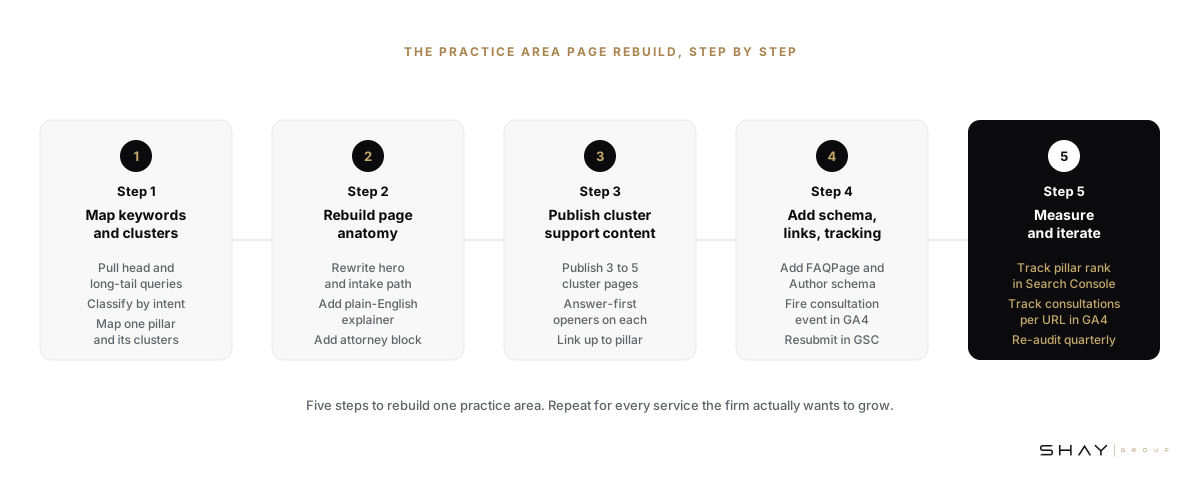
Step 1: Map keywords and clusters. Pull head and long-tail queries for the practice area, classify each by intent, and assign every one to exactly one page. Output is a cluster map: one pillar, its cluster pages, and the anchor text for each link.
Step 2: Rebuild page anatomy. Work the eight zones in order. Rewrite the hero and intake path, add the plain-English explainer, add real results with disclaimers, add jump navigation, restructure the body into question-shaped H2s with answer-first openers, and add the named attorney block.
Step 3: Publish cluster support content. Publish three to five cluster pages first, prioritizing the sub-queries from your fan-out that no competitor covers well. Every one gets an answer-first opener and a descriptive link up to the pillar.
Step 4: Add schema, links, and tracking. Ship validated Article, FAQPage, and Organization or LegalService schema with a real author entity. Add the pillar-to-cluster links from the relevant body sections. Wire the attribution stack: GA4 events, dynamic number insertion, the hidden form field, and the locked CRM source field.
Step 5: Measure and iterate. Watch consultations by landing page, not sessions. Check Search Console for queries the page is now impressing for but not ranking well on, and either strengthen the relevant section or build the cluster page it needs. Re-run the fan-out quarterly, because the questions change.
Do steps 1 through 4 for one practice area before starting the second. A single rebuilt pillar with a real cluster behind it will outperform six half-finished ones.
How SHAY Group helps
Most firms can produce content. Far fewer can connect that content to signed clients with confidence. That gap, between publishing and proving, is where we work.
SHAY Group runs SEO, GEO/AEO, content strategy, and analytics from the same data, through a repeatable process: Audit & Discovery, Strategy, Execution, Measure & Iterate. For a law firm, that means you can see which pages and clusters drive consultations, what an organic consultation costs relative to paid, and where the next content dollar produces the most incremental return. The outcome is not more content. It is a content ecosystem you can defend in a budget conversation.
Turn your practice area pages into your best marketing asset
Your practice area pages are the pages most likely to turn a searcher into a signed client. Build each one against the eight-zone anatomy, surround it with a real cluster mapped from the query fan-out, engineer visible E-E-A-T with a named attorney, keep it current on a cadence that matches your practice area, structure it so AI systems can cite it, and wire the attribution stack before you publish so you can prove what it produced. Run the five steps on one page, confirm the consultations, then repeat. If you want practice area pages that carry that weight, get in touch.
Frequently asked questions
What is a law firm practice area page?
A law firm practice area page is a dedicated page on a firm's website that describes one legal service in plain English, presents the attorneys who handle it, and gives a prospective client a clear next step. It functions as a topical pillar page: comprehensive on the practice area itself, supported by narrower blog posts and FAQs that link back to it.
How is a practice area page different from a landing page?
A landing page is built for a specific paid or campaign traffic source and is optimized for one conversion event. A practice area page is a permanent, SEO-driven pillar page that ranks in organic search, earns AI citations, and supports an entire cluster of related content. Many firms need both, but they are not interchangeable.
How long should a law firm practice area page be?
Long enough to genuinely answer the questions a prospective client has, and no longer. In practice, most competitive personal injury or criminal defense pages run 1,200 to 2,500 words with supporting cluster pages behind them. Word count is a symptom of depth, not a goal.
How many practice area pages should a law firm have?
One dedicated page per distinct service the firm actively pursues. Do not create a page for every possible sub-issue up front. Build main practice pages first, then add sub-practice and geo-targeted pages once each main page is producing consultations.
What schema should be on a practice area page?
At minimum, Article, FAQPage for the FAQ block, and Person or LegalService plus Organization schema for the firm and the named attorney. Attach Author schema to a real, credentialed attorney with a live bio page. Schema does not create authority, but its absence forfeits an easy signal.
Can practice area pages get cited in Google AI Overviews and ChatGPT answers?
Yes, when they are written as answer-first passages under question-shaped headings, mention the statutes and procedures involved by name, and are attributed to a named, credentialed attorney. On the "law firm practice area pages" AI Overview we read in July 2026, cited sources included two state bar publications, a web design portfolio, and three marketing agencies, which shows AI answers reward clear structure and authority signals as much as raw domain strength.
How often should we update practice area pages?
At least annually, and immediately when a relevant statute, procedural rule, or damages cap changes. On YMYL legal topics, current information is a direct trust signal that supports both Google rankings and AI citations.
Do we need a separate page for each city we serve?
Yes, if the market truly differs (local courts, filing rules, damages caps, or referral networks) and if you can write genuinely distinct content for each. If the only difference is the city name, build one strong page instead of fifty near-duplicates.